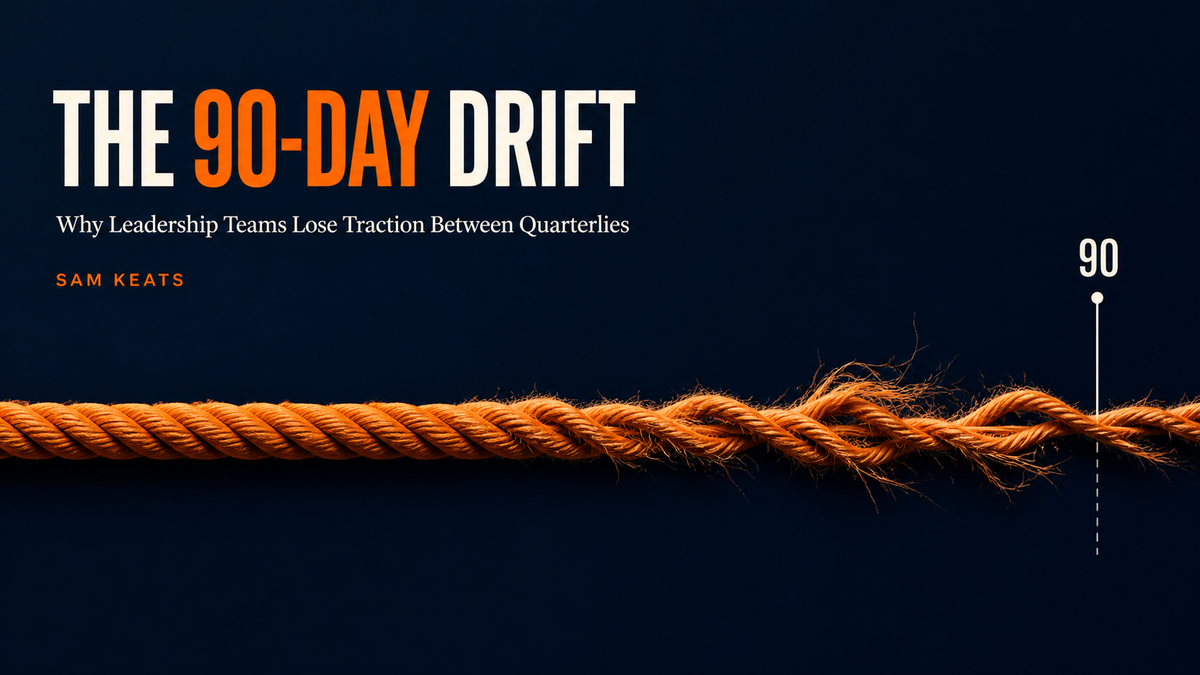
The 90-Day Drift: Why Good Leadership Teams Lose Traction Between Quarterlies
Most leadership teams leave their Quarterly Meeting aligned and energised. Then operational noise returns. Here’s how to prevent the 90-day drift.

Most leadership teams don’t leave their Quarterly Meeting confused.
They leave clear, aligned and energised.
They’ve reviewed the previous quarter honestly. They’ve reconnected with the company vision. They’ve worked through important issues and agreed on the handful of priorities that matter most over the next 90 days.
Everyone leaves knowing what they own.
Then Monday arrives.
Customers need attention. Team members need answers. New opportunities appear. Unexpected problems land on the desk. The urgent begins competing with the important.
A few weeks later, the clarity created in the Quarterly Meeting has started to fade.
The plan wasn’t necessarily wrong. The leadership team didn’t suddenly become incapable. The business simply began drifting back towards its normal habits.
I call this the 90-day drift.
After facilitating more than 800 full-day sessions with over 80 leadership teams, I’ve seen this pattern repeatedly. It affects good companies, capable leaders and teams with genuinely strong intentions.
The difference between teams that gain traction and those that repeatedly lose it is not whether drift occurs.
It is how quickly they recognise and correct it.
What is the 90-day drift?
The 90-day drift is the gradual loss of clarity, focus and accountability that can occur between quarterly planning sessions.
It rarely begins with one major failure. It happens through small compromises:
- A weekly meeting gets postponed.
- A Rock receives no meaningful attention for several weeks.
- A red number is explained rather than addressed.
- A difficult people issue is carried for a little longer.
- A leadership-team commitment becomes optional.
- An urgent operational problem consumes the time reserved for an important strategic priority.
None of these decisions feels catastrophic in isolation.
Together, however, they weaken the plan.
By the end of the quarter, the team may still be extremely busy—but it is no longer moving forward with the same clarity or discipline it had at the beginning.
The predictable pattern of drift
Every leadership team is different, but the drift often follows a recognisable pattern.
Days 1–30: confidence
The plan is still fresh.
The leadership team remembers the conversations that shaped each Rock. Ownership is clear, deadlines feel real and the team is generally confident about what can be accomplished.
This is often the strongest part of the quarter.
The risk during this period is assuming that early confidence guarantees future execution.
It doesn’t.
A Rock can appear green because its owner understands what needs to happen—not because enough work has actually been completed.
Days 31–60: competition
Normal business pressure returns.
Strategic priorities begin competing with customers, recruitment, operational issues, financial pressure and new opportunities. Some Rocks continue moving, while others remain technically “on track” without enough evidence.
This is where leadership teams begin negotiating with themselves.
“We’ll get to that next week.”
“We’re waiting on someone.”
“It’s still achievable.”
Those statements may be true. But they can also disguise a priority that has stopped moving.
Days 61–75: exposure
By this point, the truth is becoming harder to avoid.
A milestone has been missed. A dependency has not been resolved. The team realises that a Rock requires more work than expected. An issue everyone hoped would disappear is still affecting execution.
Healthy teams expose this early and solve it.
Unhealthy teams soften the language, protect the Rock owner or move the difficult conversation into the final weeks of the quarter.
Days 76–90: the scramble
The deadline creates urgency.
Some teams regain momentum and complete the work. Others redefine what “done” means, carry priorities into the next quarter or arrive at the Quarterly Meeting with explanations instead of results.
This is not usually an effort problem.
It is a visibility and accountability problem that began much earlier.
Five warning signs that your team is drifting
1. Rocks have stopped driving the weekly conversation
A Rock is not simply a task with a 90-day deadline. It is one of the most important things the business must accomplish during the quarter.
If Rocks are mentioned briefly but never generate meaningful discussion, they may have become reporting items rather than genuine priorities.
When a Rock is off track, the objective is not to defend it. The objective is to identify the obstacle and solve it.
2. Red numbers remain red without producing action
A Scorecard should give the leadership team an early warning system.
A red number is not a personal failure. It is information.
The problem begins when the same number remains red week after week while the team accepts a new explanation each time. Eventually, red becomes normal and the Scorecard loses its power.
Every important red number should lead to one of three things:
- A clear explanation that resolves the concern
- A To-Do that creates action
- An issue that the leadership team identifies, discusses and solves
3. Important issues move underground
Leadership teams rarely run out of issues.
They stop raising the real ones.
People may worry about creating tension, challenging a colleague or opening a conversation they cannot quickly resolve. The issue remains present, but it disappears from the Issues List.
It then surfaces indirectly through missed commitments, guarded communication, recurring mistakes or decisions that never quite stick.
Healthy teams make it safe—and expected—to put the real issue on the table.
4. Everyone is busy, but the priorities are not moving
Busyness can create the illusion of traction.
A leadership team can work extremely hard while making little progress on the priorities that will materially strengthen the business.
The weekly question is not simply:
“What did we work on?”
It is:
“What moved forward?”
Activity matters. Progress matters more.
5. Accountability becomes personal
When accountability is weak, leaders often avoid it because they don’t want to appear critical or unsupportive.
But healthy accountability is not an attack. It is the team protecting the commitments it made together.
The leadership team should be able to say:
“You committed to this. It appears off track. What is getting in the way, and what needs to happen next?”
That is not blame. It is leadership.
The Level 10 Meeting protects the quarterly plan
The Quarterly Meeting creates the plan.
The weekly Level 10 Meeting™ protects it.
Its purpose is not to fill an agenda or provide general updates. It gives the leadership team a consistent place to examine reality.
Are our Rocks on track?
Are our numbers telling us something important?
Did we complete what we committed to last week?
What issue most needs to be solved today?
When the meeting pulse weakens, drift accelerates.
Meetings are postponed. Attendance becomes flexible. The Issues List fills with operational noise. The team spends more time sharing information and less time making decisions.
Whether your leadership team meets weekly or has intentionally chosen another pulse, consistency matters. Protect the time, start on time, finish on time and use the meeting to solve—not merely discuss.
Three checkpoints that reduce the drift
The Quarterly Meeting should not be the first time the team confronts the quarter’s results.
Three simple checkpoints can help.
Day 30: test the foundations
Ask:
- Does every Rock have one clear owner?
- Does “done” mean the same thing to everyone?
- Has meaningful work commenced?
- Are any dependencies already creating risk?
- Does the team still believe these are the right priorities?
The goal is not to rewrite the quarter. It is to make sure each priority has a strong foundation.
Day 60: challenge the evidence
Ask:
- What objective evidence shows that each Rock is on track?
- Which milestone should already have been completed?
- What are we avoiding?
- Which Rock needs support from another member of the team?
- If nothing changes, what is likely to remain incomplete?
This is often the most valuable checkpoint because there is still enough time to respond honestly.
Day 75: force clarity
Ask:
- What must happen during the next two weeks?
- What decision can no longer be deferred?
- What needs to be removed or deprioritised?
- Who needs help?
- Are we genuinely on track, or merely hopeful?
Hope is not a completion strategy.
Hold the 90-day world sacred
There will always be reasons to move a Quarterly Meeting.
A customer crisis. Unexpected leave. Travel. A major opportunity. Someone important cannot attend.
Occasionally, rescheduling may be unavoidable. But it should be the exception.
There will never be a quarter in which life stops happening.
Holding the quarterly pulse sacred teaches the organisation that its priorities, commitments and vision matter. It also reinforces that the leadership team is bigger than any one person.
If someone cannot attend, the team can still make progress. A participant can take a To-Do to brief the absent leader, confirm the wording of a Rock or obtain final sign-off on a decision.
Momentum is protected without ignoring the absent person’s contribution.
The same principle should eventually permeate the departments. Departmental planning should not collapse whenever one person is unavailable. The organisation learns to maintain its rhythm while still creating clear follow-up and communication.
Five questions for your leadership team
At your next meeting, ask:
- Are our Rocks genuinely on track—or have we simply stopped challenging them?
- Which red number have we become too comfortable explaining?
- What issue are we reluctant to put on the Issues List?
- Where are we confusing activity with progress?
- What commitment have we allowed to become optional?
The answers will tell you whether your team is executing the quarterly plan or gradually drifting away from it.
The goal is not perfection
No leadership team executes every quarter perfectly.
The objective is not to eliminate every distraction, predict every obstacle or complete every Rock at any cost.
The objective is to build a leadership team that notices reality early, speaks openly and corrects course before drift becomes failure.
A strong Quarterly Meeting creates clarity.
A strong weekly meeting pulse maintains it.
And a healthy leadership team holds one another accountable for turning the plan into results.
That is how traction is built—not in one exceptional planning day, but through the discipline shown during all the ordinary days that follow.
I’m Sam Keats, a Perth-based Expert EOS Implementer®. I help entrepreneurs and leadership teams implement EOS®, strengthen accountability and gain traction. I’ve facilitated more than 800 full-day leadership-team sessions with over 80 companies.
If your leadership team is considering EOS implementation in Perth, I’m happy to explain the process, answer your questions or connect you with an EOS Implementer who may suit your team.